
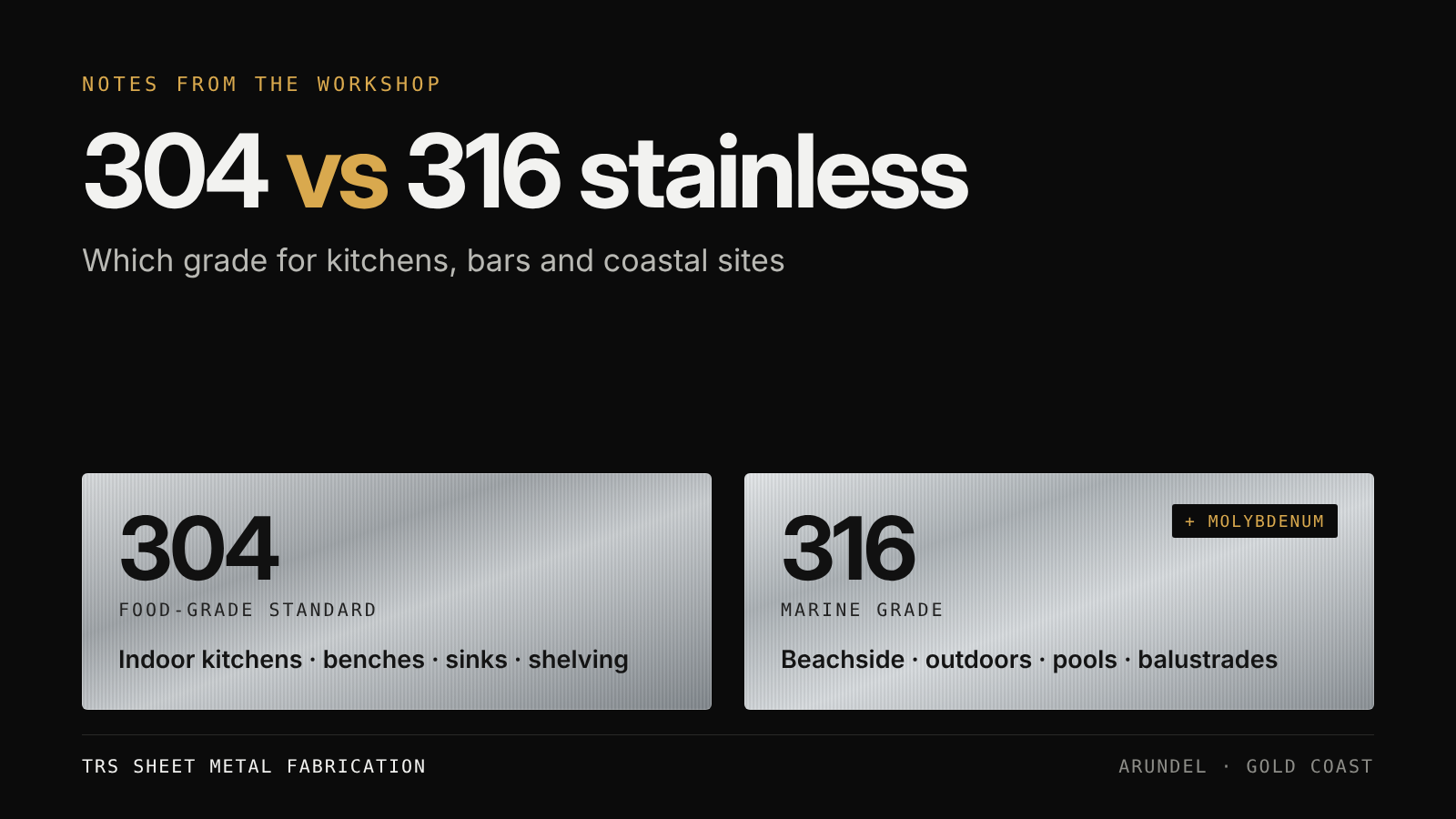
"Should this be 304 or 316?" is one of the most common questions we get on quotes. Both are stainless steel, they look the same on the day they're installed, and 316 costs more. So it's fair to ask whether it's worth it.
The short answer: 304 suits most indoor work, and 316 earns its keep near the coast, outdoors, and anywhere salt or harsh chemicals are involved. On the Gold Coast, that covers more jobs than people expect.
What's the difference?
Both grades are austenitic stainless steels, made mostly of iron, chromium and nickel. The chromium is what makes stainless "stainless": it forms a thin protective layer on the surface that repairs itself when scratched.
316 has a bit more nickel, plus a small amount of molybdenum. That molybdenum is the important part. It makes 316 much better at resisting chlorides, which means salt, salty air, pool water and some cleaning chemicals.
In the workshop they cut, fold and weld much the same, and you can't tell them apart by eye. The difference shows up months or years later, in how they hold up.
When 304 is the right choice
304 is the standard food-grade stainless, and it's what most commercial kitchen benching is made from. It's a good choice for:
indoor commercial kitchens away from open doors and salt air
benches, shelving, sinks and splashbacks
back-of-house fit-outs in shopping centres and inland suburbs
anything that's indoors, cleaned regularly and kept dry
If your job suits 304, there's no point paying for 316. We'll tell you when that's the case.
When 316 is worth paying for
316 is the grade to use where salt and moisture get at the steel:
Near the beach. Salt in the air settles on stainless and attacks it over time.
Outdoors. Outdoor bars, outdoor kitchens, balustrades, handrails and gates.
Around pools. Pool water and the air around it are full of chlorides.
Harsh cleaning or brines. Kitchens that use strong chlorine-based cleaners or salty brines.
Venues that open onto the street or the beach, where sea air blows into the kitchen or bar.
Tea staining: the Gold Coast problem
If you've seen brown, rusty-looking marks on stainless rails along the beachfront, that's tea staining. It's surface corrosion caused by salt sitting on the steel.
According to the Australian Stainless Steel Development Association (ASSDA), tea staining is most common within about five kilometres of the surf, and it gets worse the closer you get to the water. Wind and heat can carry it further inland.
On the Gold Coast, a lot of homes, venues and businesses sit inside that zone. 304 used outdoors there will often tea stain, and sometimes corrode further. 316 is far more resistant. ASSDA notes that tea staining is mainly a cosmetic problem rather than a structural one, but nobody wants a brown balustrade on a new build.
Grade isn't the only thing that matters
Even 316 can tea stain on the coast if it's not looked after. A few things help a lot:
A smooth finish. Smoother surfaces hold less salt and dirt, so polished stainless resists staining better than a rough finish.
Good design. Avoiding crevices and ledges where salt and water sit.
Clean welds. Welds cleaned up properly after welding resist corrosion better.
Regular washing. Rinse outdoor stainless with fresh water and wipe it down. The closer to the beach, the more often it needs it. Rain helps on exposed surfaces, but sheltered spots like under eaves miss out.
How to decide
Indoor kitchen, inland or in a shopping centre: 304
Indoor kitchen near the beach, or opening onto the street: 304 inside, 316 near doors and openings (ask us)
Outdoor bar or outdoor kitchen: 316
Balustrades, handrails and gates near the coast: 316
Around pools: 316
Every site is different, so treat this as a starting point. Tell us where the job is when you send drawings, and we'll recommend a grade as part of the quote.
Not sure which grade you need?
Send your drawings through and tell us where the job is. We'll recommend a grade and come back with a free, no-obligation quote. Call Tyler on 0497 829 990, email admin@trsfabrication.com.au, or request a quote online.
Read more on stainless steel for commercial kitchens, or see everything we make.