
Metal fabrication covers a lot of methods: laser cutting, machining, punching, stamping and more. Most jobs only need a few of them. In our Arundel workshop on the Gold Coast, nearly every stainless, steel and aluminium job follows the same six steps, from flat sheet to installed.
Here's what happens to your job at each one, using a stainless bench top as the example.
1. Drawings
Every job starts on paper. We work from your shop drawings, or help you put them together if you don't have them. Sizes, material grade, thickness and finishes are agreed and signed off before anything is cut.
This is the step that saves the most time and money later. Changing a line on a drawing is easy. Changing a folded and welded bench is not.
2. Cutting
The sheet goes through the guillotine and is cut to the sizes on the drawing. Holes and fixing points are drilled. Parts are laid out on the sheet to waste as little material as possible.
We don't laser cut in-house. For most benching, splashbacks, shopfronts and brackets, guillotining and drilling is fast and accurate. Where a job needs laser-cut parts, such as a detailed decorative screen, we organise that as part of the job.
3. Folding
The cut sheet is bent to shape on our 4 metre hydraulic press brake. Folding is what turns a flat sheet into a bench top with upstands, a nosing or a splashback.
The 4 m length matters. A long bench top or splashback can be folded in one piece rather than joined, which looks better and is easier to keep clean.
4. Welding
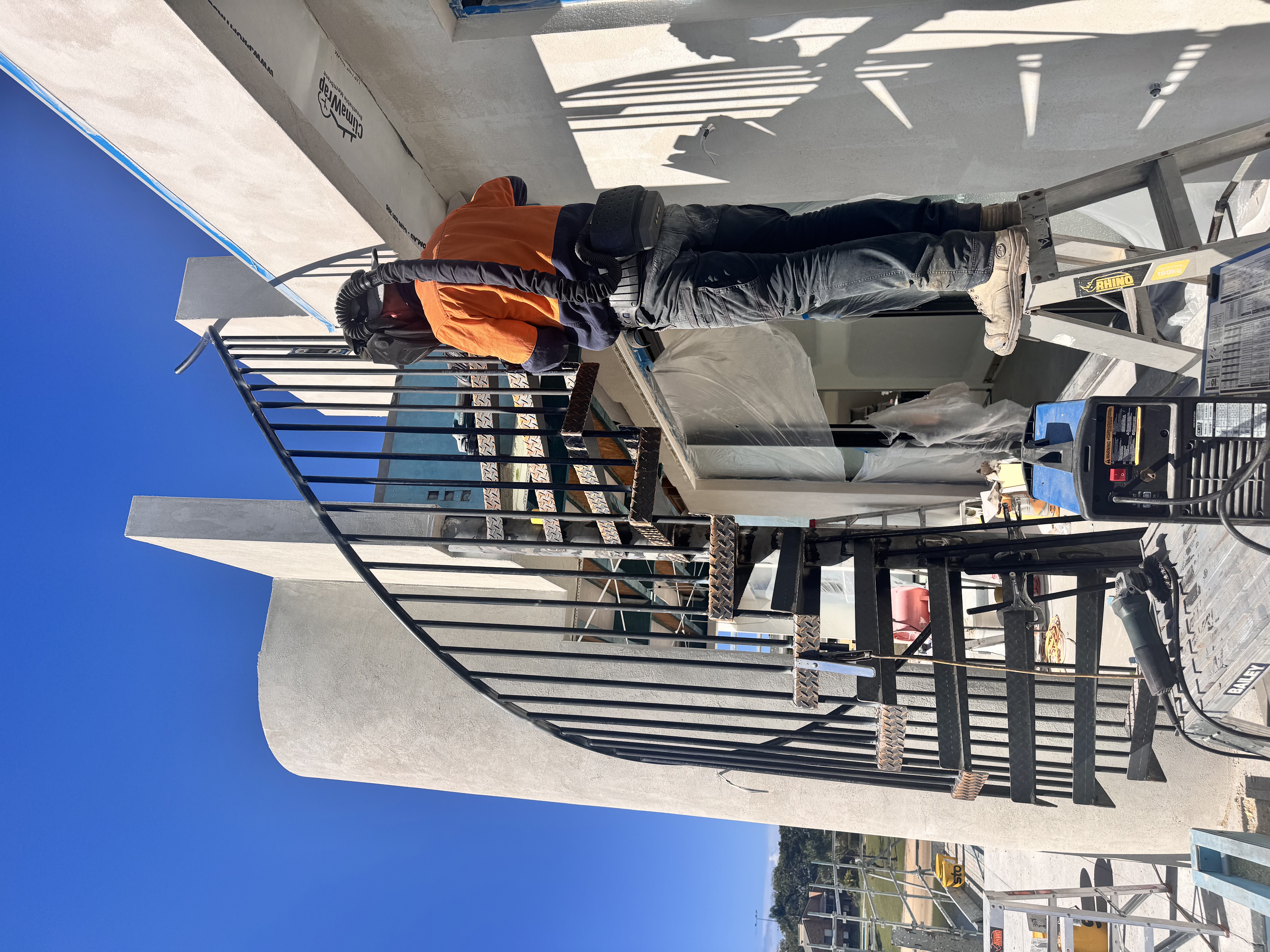
We TIG and MIG weld stainless, mild steel and aluminium.
TIG welding gives a clean, precise weld. It's what we use for most stainless work, where joints need to be neat and easy to clean, such as bench corners and sinks.
MIG welding is faster and suits heavier steel work like frames, posts and structural parts.
For a bench, this is where the top, legs, undershelf and any sinks come together into one solid unit.
5. Finishing
The finish depends on the job and where it's going:
Raw for parts that will be hidden or painted later
Brushed stainless, the standard for commercial kitchens
Polished stainless, for front-of-house pieces that need to look sharp
Powder-coated steel and aluminium, in almost any colour, for screens, shopfronts and balustrades
Anodised aluminium, for a hard-wearing finish that holds its colour
Welds on stainless are cleaned up so the finish is consistent across the whole piece.
6. Install
We deliver the finished work and install it on site across the Gold Coast, Brisbane and northern NSW. For hospitality clients, we also come back for maintenance when something needs fixing.
The methods we don't use
You'll see machining, punching and stamping on lists of fabrication methods. They suit mass production and machined parts, which isn't the work we do. Our workshop is set up for made-to-measure stainless, steel and aluminium for shopfitters, builders, contractors and hospitality operators.
Got a job for the workshop?
Send your drawings through and we'll come back with a free, no-obligation quote. Call Tyler on 0497 829 990, email admin@trsfabrication.com.au, or request a quote online.
See our full process and everything we make, or read why commercial kitchens use stainless steel.